
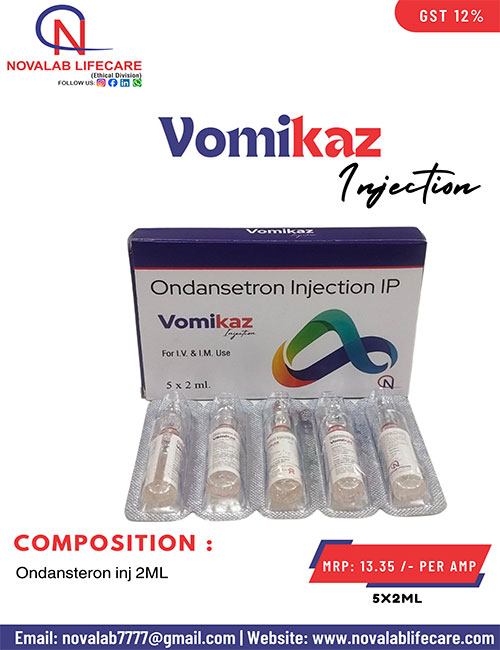
VOMIKAZ
|
Feature |
Specification |
| Brand Name | Vomikaz Injection |
| Generic Name | Ondansetron Injection IP |
| Active Ingredient | Ondansetron |
| Strength per ml | 2 mg / ml |
| Total Strength | 4 mg per 2 ml Ampoule |
| Pharmacopoeia | IP (Indian Pharmacopoeia) |
| Dosage Form | Liquid Injection |
| Route of Admin | I.V. (Intravenous) & I.M. (Intramuscular) Use |
Effective management of nausea and vomiting is critical in clinical recovery and patient comfort. VOMIKAZ, a high-quality pharmaceutical formulation from Novalab Lifecare, features Ondansetron Injection IP (2mg/ml). Classified as a potent antiemetic, VOMIKAZ is specifically engineered to prevent and treat nausea and vomiting induced by surgery, chemotherapy, or radiotherapy.
By utilizing a targeted mechanism of action, VOMIKAZ provides rapid stabilization for patients, ensuring that the symptoms of emesis (vomiting) do not interfere with vital medical treatments or postoperative healing.
The efficacy of VOMIKAZ lies in its active pharmaceutical ingredient, Ondansetron. Understanding its biological role is essential for healthcare providers and patients alike.
Selective 5-HT3 Receptor Antagonism
Ondansetron belongs to the class of medications known as selective serotonin 5-HT3 receptor antagonists. During emetogenic (vomit-inducing) events, such as chemotherapy or surgical trauma, the body releases serotonin (5-HT). This serotonin binds to 5-HT3 receptors located in both the gastrointestinal tract and the Chemoreceptor Trigger Zone (CTZ) in the brain.
When these receptors are activated, they send signals to the vomiting center of the brain. VOMIKAZ works by blocking these receptors, effectively stopping the “vomit signal” before it results in physical discomfort.
VOMIKAZ is provided in a 2ml ampoule (4mg total dose) for intravenous (I.V.) or intramuscular (I.M.) administration. This route is superior for acute cases because:
VOMIKAZ is utilized across several specialized medical fields to maintain patient stability and hydration.
1. Post-Operative Nausea and Vomiting (PONV)
Nausea is one of the most common side effects of general anesthesia. VOMIKAZ is often administered at the induction of anesthesia to prevent these symptoms from occurring or as a rescue medication in the recovery room. Reducing PONV is essential for preventing surgical site infections and allowing patients to begin oral intake of fluids sooner.
2. Chemotherapy-Induced Nausea and Vomiting (CINV)
Cancer treatments involving cytotoxic chemotherapy are highly emetogenic. VOMIKAZ provides a robust defense, helping patients tolerate multiple cycles of treatment without the debilitating exhaustion caused by constant vomiting. It is typically administered 30 minutes before the start of a chemotherapy session.
3. Radiotherapy-Induced Nausea
Patients undergoing total body irradiation or localized radiation to the abdomen often experience significant gastric distress. VOMIKAZ offers a reliable solution to manage these side effects, ensuring the continuity of the treatment plan.
VOMIKAZ is manufactured under the Novalab Lifecare commitment to pharmaceutical excellence.
VOMIKAZ is an ethical division product and must be administered under the supervision of a healthcare professional.
While generally well-tolerated, some patients may experience:
1. What is VOMIKAZ used for?
VOMIKAZ is an antiemetic injection used to prevent and treat nausea and vomiting caused by surgery, cancer chemotherapy, or radiation therapy.
2. How quickly does VOMIKAZ start working?
When administered intravenously, VOMIKAZ begins to take effect almost immediately, with significant relief usually occurring within 15 to 30 minutes.
3. Can VOMIKAZ be used for motion sickness?
No. Ondansetron is highly effective for chemotherapy and surgery-induced nausea, but it is generally not effective for motion sickness (seasickness), which involves different pathways in the inner ear.
4. Is VOMIKAZ safe for pregnant women?
Ondansetron is sometimes prescribed for severe morning sickness (Hyperemesis Gravidarum), but it should only be used during pregnancy if explicitly directed by a doctor, especially during the first trimester.
5. Are there any medications that interact with VOMIKAZ?
Yes. VOMIKAZ should not be used with Apomorphine, as it can lead to a severe drop in blood pressure. Always inform your doctor of all current medications, especially those affecting heart rhythm.
6. Does VOMIKAZ cause drowsiness?
Unlike older anti-nausea medications, VOMIKAZ is a selective blocker and does not typically cause significant sedation or “brain fog.”
7. Can it be given as a muscle injection (I.M.)?
Yes, VOMIKAZ is formulated for both Intravenous (I.V.) and Intramuscular (I.M.) use. Your healthcare provider will determine the best route based on your condition.
8. Why is VOMIKAZ preferred over oral tablets in emergencies?
In cases of active vomiting, a tablet may be thrown up before the body can absorb it. An injection ensures the full dose enters the system regardless of the patient’s ability to swallow.